What is rhinoplasty?
Rhinoplasty is an operation combining cosmetic and functional improvement of the nose. It is not limited to improving the shape; it works on the structure of the nose with architectural precision to achieve:
- balance with the rest of the face.
- the right proportions and symmetry.
- a nose that stays stable over time.
- good breathing function.
The aim is not to create an ‘idealised’ nose, but a nose that genuinely suits you.
Is it right for me?
It is for people who want to improve their nose without changing the overall look of their face. For example, if:
- You are unhappy with the shape or proportions of your nose.
- There is asymmetry or a hump that affects your profile.
- You have difficulty breathing due to anatomical causes.
- You want an improvement with a natural look, not a change of identity.
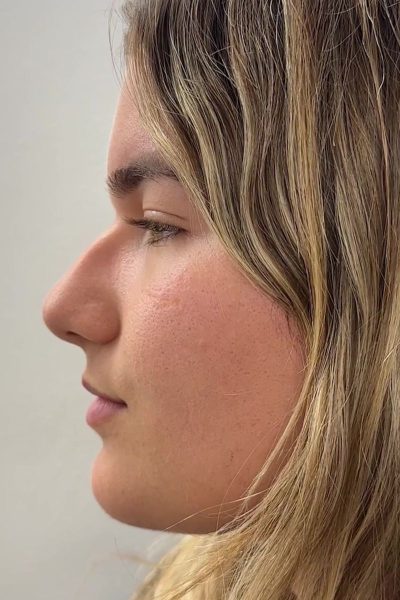
Rhinoplasty: the process
Consultation
We assess your nose, your face and your breathing, and set realistic goals.
Planning
We plan each step precisely, for a natural, balanced result.
Procedure
Bone and cartilage are carefully corrected, improving the shape and function of the nose.
Recovery
A gradual recovery follows, with aftercare instructions and check-ups, as the result settles over time.
Closed rhinoplasty
Closed rhinoplasty is carried out under general anaesthetic and all the incisions are made inside the nostrils, with no external scar. It is a more discreet technique, used in selected cases where the corrections are specific and extensive reshaping is not needed.
Through the internal incisions, the framework of the nose is carefully reshaped, working on bone and cartilage to achieve a natural cosmetic improvement and, where needed, better function.
Closed rhinoplasty may include:
- removing a hump.
- gentle refining or narrowing of the tip.
- corrections that improve symmetry and profile.
At the end of the operation, a splint is placed to hold the nose in position while it heals.
Open rhinoplasty
Open rhinoplasty is chosen for more complex or demanding cases, where greater precision and full control of the nasal anatomy are needed. As well as the internal incisions, a small, discreet incision is made at the base of the nose, which usually heals well and becomes hard to see.
This technique gives direct access to the cartilage and bone, which allows detailed planning and a stable reconstruction of the nose.
Open rhinoplasty is often used when there is a need for:
- extensive reshaping of the tip of the nose.
- cartilage grafts (usually from the septum) for support.
- correction of significant asymmetry.
- a combination with septoplasty to improve breathing.
As with the closed technique, at the end of the operation the incisions are carefully closed and a splint is placed for proper healing and a stable result.
Which rhinoplasty technique is right for me?
The choice between closed and open rhinoplasty is not based on personal preference, rather on the structure of your nose, your cosmetic and functional goals, and the degree of change needed.
Closed rhinoplasty may be suitable when the changes needed are specific and limited. This usually means cases where the main issue is a hump or the profile, where any changes to the tip are minor, and where there is no marked asymmetry.
Open rhinoplasty is recommended when greater precision and control are needed. It is suggested for more complex cases, such as marked asymmetry, extensive reshaping of the tip, the need for cartilage grafts, breathing problems, and/or revision surgery.
The final decision is always made after a detailed, personal assessment in clinic. There, we look not only at what you would like to change, but also at what your nose really needs, so that the result suits your face and works well day to day.
BENEFITS
- Cosmetic and functional improvement together.
- A natural result in harmony with your face.
- Correction of asymmetry.
- Improved breathing.
- Long-lasting, stable results.
- A personal approach.
AT A GLANCE
Procedure time
1–3 hours
Anaesthetic
General
How long results last
Long-lasting
Recovery
1–2 weeks
Hospital stay
None
Extras
Compression garment for 1 month
Cost
From €150
Non-surgical “rhinoplasty” with hyaluronic acid
Non-surgical rhinoplasty is a non-surgical cosmetic technique that uses hyaluronic acid to correct minor irregularities of the nose.
With targeted injections we can smooth small irregularities, “fill” dips and create a straighter-looking profile.
The procedure is quick, generally well tolerated and needs little or no downtime. The result lasts 9–18 months, depending on the individual.
However, it has limitations. It does not reduce size, does not improve breathing, and offers a purely cosmetic improvement. For more complex cases, surgical rhinoplasty is the recommended option.
Frequently asked questions
Is rhinoplasty painful?
The operation is carried out under general anaesthetic, so you won’t feel pain during it. Afterwards, most patients describe a mild feeling of pressure or heaviness in the nose, which is usually well controlled with simple painkillers and which eases over the first few days.
Will I have bruising and swelling?
Mild swelling is expected and is a natural part of healing. Bruising, if it appears, is usually limited and fades within 7–14 days. How much you get varies from person to person and depends on the type of rhinoplasty.
When can I go back to work?
Most patients return to desk-based work after about 7–10 days. Strenuous physical activity and exercise should be avoided for 3–4 weeks.
Will my face change a lot?
As I see it, the aim of rhinoplasty is not to change your face but to bring it into balance. The result should look natural and suit your features, without shouting that you have had surgery.
When will I see the final result?
An initial result can be seen as soon as the splint is removed. However, the nose continues to improve gradually. The final result usually settles within 6–12 months, as the swelling goes down completely and the tissues adapt.
Are there scars after rhinoplasty?
With closed rhinoplasty there are no external scars. With open rhinoplasty there is a very small incision at the base of the nose, which becomes harder to see over time.
Are the results of rhinoplasty long-lasting?
The results of rhinoplasty are long-lasting, provided the operation has been planned properly and the aftercare instructions are followed.
Can my breathing be improved too?
Yes. In many cases, rhinoplasty is combined with functional surgery (e.g. on the septum), which can noticeably improve breathing.
My philosophy

My role is not to impose a standard, but to understand in depth each person’s anatomy, needs and expectations.
For me, rhinoplasty is a process of bringing into balance, rather than being one of ‘change’. I don’t believe in overdoing it, or in faces that lose their identity in the name of perfection.